
We use the word resilience constantly in leadership.
We want resilient employees.
Resilient teams.
Resilient organisations.
Resilient leaders.
But I increasingly wonder whether we always mean the same thing.
Sometimes what organisations call resilience actually means:
Keep going.
Don’t complain.
Handle the pressure.
Push through.
Get the result.
From the outside, that can look strong.
But is it really resilience?
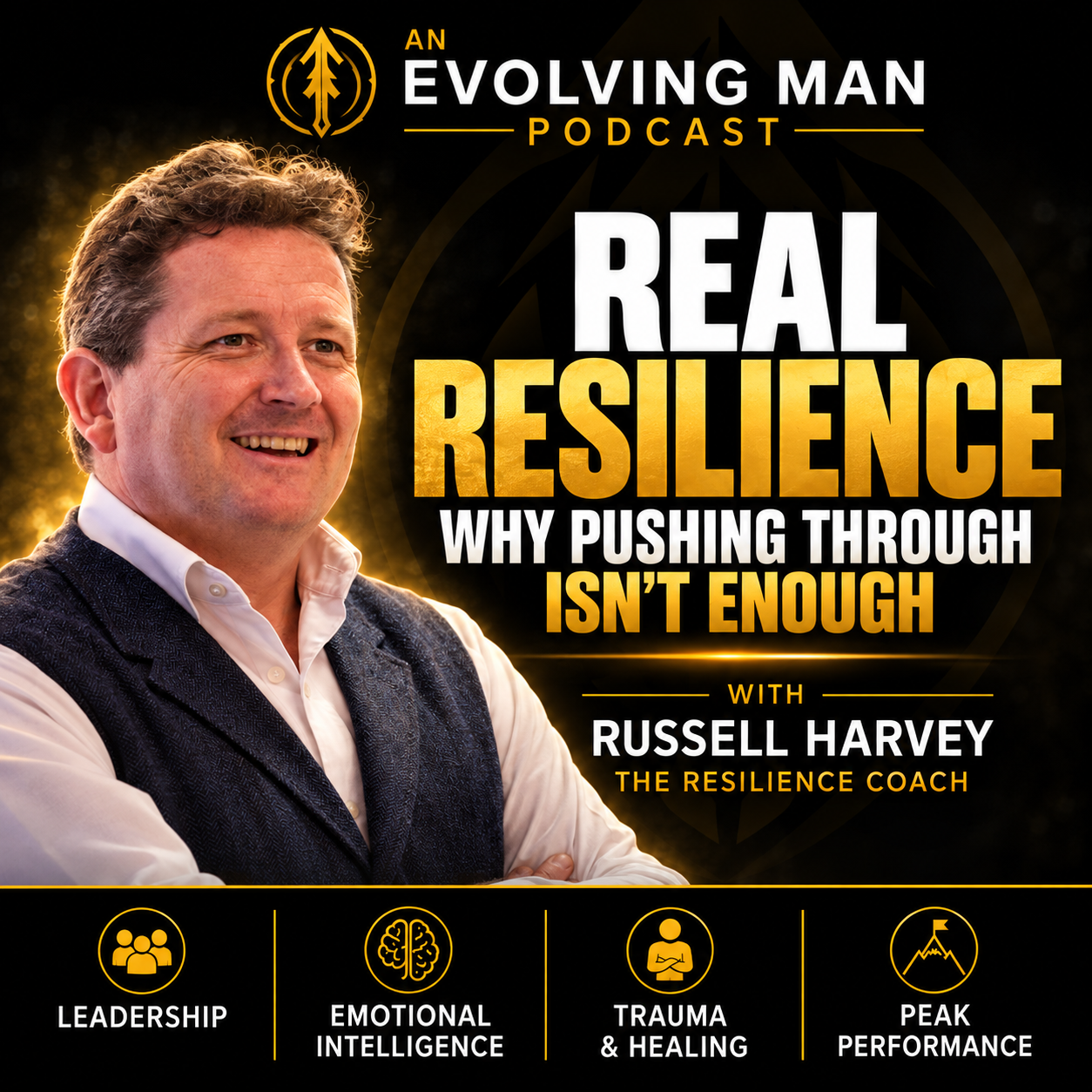
That was one of the central questions in my recent conversation with Russell Harvey, The Resilience Coach, on An Evolving Man Podcast.
Russell has spent many years working in learning, leadership and organisational development and now focuses specifically on helping leaders navigate persistent change. Pasted text
What struck me most was how closely his definition of resilience aligns with what we explore through compassionate leadership: resilience is not emotional suppression.
It is not endless endurance.
It is not pretending everything is fine.
It is the ability to remain connected to ourselves, learn, adapt and respond well.
“Springing forward with learning”
Russell describes resilience as:
“Springing forward with learning.”
I like that phrase enormously.
It changes resilience from something passive—
“I survived.”
—to something developmental:
“What did I learn, and how am I going to respond differently?”
This matters because surviving something difficult does not automatically mean we have processed it.
We may simply have endured it.
Russell distinguishes between surviving, coping and thriving.
Surviving can feel like hanging on by our fingernails.
Coping may mean:
“I’m okay. Just about.”
Thriving is different.
It is being able to acknowledge:
“There is a lot going on. The world is difficult. And I am genuinely okay.” Pasted text
That is a very different definition of resilience from simply being able to absorb more punishment.
Resilience or dissociation?
This part of our conversation particularly interested me because of my own work around boarding school.
Boarding schools often describe themselves as developing resilience.
But I have questioned that for years.
If a child learns:
don’t cry,
don’t show fear,
don’t ask for help,
don’t appear homesick,
keep going whatever happens,
is that resilience?
Or has the child learned to disconnect from their feelings in order to survive?
There is an important difference.
Russell spoke about situations where people have little opportunity to reflect on what they feel, question what is happening or have a meaningful conversation about the experience.
Instead, the message becomes:
This is the system. Adapt to it.
So we protect ourselves.
Shut down.
Go inward.
Keep functioning. Pasted text
Externally, that can look impressive.
Internally, it may be dissociation.
I’ve explored this distinction previously in Are We Teaching Resilience or Dissociation?. The central question remains extremely relevant to modern workplaces: are we genuinely helping people grow stronger, or merely increasing how much dysfunction they can tolerate? Compassionate Leaders Global
Emotional intelligence is central to resilience
One of the most important aspects of Russell’s work is that resilience requires considerable emotional intelligence.
I agree.
To be resilient, I first have to know:
What is actually happening inside me?
Am I tired?
Angry?
Scared?
Overwhelmed?
Excited?
Grieving?
Do I need to keep going?
Or do I need to stop?
That requires awareness.
And then it requires judgement.
Russell shared a useful question:
“Is what I’m about to do going to be helpful or harmful?”
That simple question creates a pause.
And inside that pause sits choice. Pasted text
Without awareness, we react automatically.
With awareness, we regain some agency.
That is why I see emotional intelligence and compassionate leadership as deeply connected to resilience. Compassionate Leaders Global
Purpose helps us navigate pressure
Russell also sees purpose as one of the foundations of resilience.
When he asks leaders:
“What is your purpose?”
many struggle to answer.
Yet when someone becomes clearer about why they are doing what they do, decision-making can change considerably.
Should I take on this project?
Should I continue working this way?
Should I say yes?
Should I say no?
Does this opportunity actually align with who I am and what matters to me?
Purpose becomes a filter.
Russell asks questions such as:
What do you want to be known for?
What’s important to you?
How do you want other people to describe you?
These aren’t abstract philosophical questions.
They can become practical leadership tools. Pasted text
Purpose is also a central part of our Compassionate Leader Pathway, because sustainable leadership is difficult when we have no meaningful answer to the question:
Why am I doing this? Compassionate Leaders Global
Stop fixing everything that’s wrong with you
Another part of our conversation I particularly enjoyed concerned strengths.
Many leaders are conditioned to focus almost exclusively on deficits.
What am I bad at?
What is my weakest score?
Where am I underperforming?
What do I need to fix?
Russell takes a different approach.
He asks:
What gives you energy?
What do you naturally enjoy doing?
Where are you at your best?
His argument is not that we can ignore weaknesses entirely.
Sometimes we simply have to do things we aren’t naturally energised by.
But there is a huge difference between managing an unavoidable weakness and building an entire career around fixing everything we dislike about ourselves.
For Russell, the more time we spend using our natural strengths, the more likely we are to add energy rather than continually deplete it. Pasted text
This feels especially relevant to leaders approaching burnout.
A useful weekly question might be:
Did last week add to my energy—or drain it?
And then:
What can I do differently next week?
Three questions for resilience
Russell offered a very practical reflection.
Pause and ask:
What have I been doing recently that serves my resilience?
What have I been doing that doesn’t serve it?
How can I do more of what is working?
Simple.
But useful.
The key word is pause.
A pause might be:
walking,
journalling,
reading,
speaking with somebody,
sitting quietly,
listening to a podcast,
or staring out of the window.
It creates enough space to notice what we are doing before habit simply carries us forward. Pasted text
For many high-performing leaders, the difficult part isn’t knowing what to do.
It is stopping long enough to notice what is happening.
Toxic resilience
Russell uses the phrase toxic resilience.
I think this is important.
It sounds like:
“You just need to be more resilient.”
“You need to be more positive.”
“Everyone’s under pressure.”
“This is just how it is.”
Often that message is delivered to an employee who is accurately identifying that something in the organisation is not working.
Instead of listening, the system pathologises the individual.
The organisation remains unchanged.
The employee is told to become stronger.
Russell argues that this can sit alongside toxic positivity: the insistence that people remain positive even when the underlying conditions genuinely need attention. Pasted text
This is not compassionate leadership.
Compassionate leadership does not mean avoiding difficult realities.
It means being willing to face them.
Wellbeing cannot compensate for unhealthy culture
This led to one of Russell’s more provocative ideas:
A genuinely resilient organisation should not need to rely on a wellbeing strategy to compensate for its normal way of operating.
His point isn’t that wellbeing programmes are bad.
Rather:
If people are continually overwhelmed by unhealthy systems, offering gym membership, fruit or a wellbeing app does not solve the deeper issue.
It can become a sticking plaster.
Leadership culture matters.
How people are treated matters.
Autonomy matters.
Purpose matters.
Psychological safety matters.
Good management matters.
In other words:
We need to fix the conditions as well as support the individual.
The three jobs of the resilient leader
Russell simplifies resilient leadership into three responsibilities.
First:
Delegate effectively according to people’s strengths and remove barriers that prevent them performing.
Second:
Develop the resilience of the team.
Third:
Develop your own resilience.
Then he asks leaders to look at their diary.
How much of your week actually fits into those three categories?
For many, the answer is:
Not very much. Pasted text
That is a powerful question.
Leadership can become so full of administration and firefighting that the leader no longer has enough time to actually lead.
Psychological safety does not mean avoiding difficult conversations
Russell also made an important distinction around psychological safety.
Psychological safety does not mean everyone being comfortable all the time.
It means difficult subjects can be discussed without people being humiliated, silenced or punished for raising them.
Rather than:
“Why did you mess this up?”
perhaps:
“Tell me more.”
“What happened?”
“What needs to happen now?”
A psychologically safe culture can have difficult conversations constantly.
They simply don’t have to feel threatening.
That distinction is fundamental to high-performing teams. Pasted text
Optimism grounded in reality
Russell ended with another idea I particularly liked:
optimism grounded in reality.
That is very different from positive thinking.
The challenge may genuinely be enormous.
Say so.
Don’t pretend otherwise.
But reality also includes:
our strengths,
our skills,
our relationships,
our experience,
our resilience,
and the resources we already possess.
When we hold both sides—
This is difficult.
and:
We have something to work with.
—we create hope.
That is not fantasy.
It is a broader view of reality. Pasted text
From endurance to thriving
Perhaps the biggest shift is this:
Resilience is not asking:
How much more can I endure?
It is asking:
What do I need in order to respond well to what is happening?
That includes toughness sometimes.
But it also includes:
rest,
purpose,
reflection,
emotion,
support,
adaptability,
strengths,
community,
and compassion.
At Compassionate Leaders Global, our mission is to help leaders thrive rather than merely survive — building clarity, emotional intelligence, resilience and sustainable performance. Compassionate Leaders Global
And perhaps that is the distinction we most need to remember.
Resilience isn’t becoming harder.
It is becoming better able to remain fully human when life becomes difficult.
Watch Episode 172 of An Evolving Man Podcast:


